CTIN
534: Experiments in Interactivity I
Instructors: Bernie DeKoven and Tracy Fullerton
Contact Info:
|
Bernie DeKoven |
Tracy Fullerton |
|
(310) 792-7227 |
(310) 390-5520 |
|
|
Course Description: This course is the first in a two-semester sequence which will introduce students to a variety of concepts in interactivity and teach creative techniques for conceptualizing and producing original interactive projects. The sequence approaches interactivity as a participatory art form, with the designer’s goal to provide a specific and meaningful experience for the users and to respond quickly and creatively to feedback during the design process. In the first semester, the exercises focus on low- and non-technical forms of interactivity, experimenting with games, improvisational theater, fine arts, toys, interactive narrative, and real and virtual play spaces. The second semester will extend these explorations to digital technologies and immersive environments.
Much of an interactive designer’s success lies in their ability to set interesting and original experience goals – and also to adapt their original design concepts in the face of constantly changing criteria for success. Demands for change may come from the audience, the client, the market, or their own artistic process. All too often, the closer a design is to completion, the more often and drastic the demands for change become. Thus, a successful designer learns to rely on an ability to improvise, to respond playfully and creatively, to work with increasingly narrow limitations and assets, while never losing sight of the overall experience goals.
A central purpose of this course, therefore, is to give students the opportunity to explore and strengthen their abilities to improvise within their own design process, provide them with a wider repertoire of resources upon which to draw, and to help them maintain their focus on the core user experience that anchors the design concept. After the first two classes, which establish the twin focal points of playfulness and improvisation, students will:
·
experience the fundamentals of improvisation as
it applies to both theatrical and interactive development through participation
in a variety of exercises
· explore fundamental principles of the psychology of fun, the sociology of playfulness and the art of improvisation
· address issues of agency, empathy, control, creativity, collaboration and the natural tension that occurs between artist and audience when the audience has a part in making the art
Meeting Information:
Thursday 6:30 – 9:30PM
Zemeckis
Media Lab, on the second floor of the
Evaluation of student performance:
a. Assignments (see full
descriptions below):
1. In-class design exercises
2. Design projects (3)
3. Student weblog
b.
Criteria
for grading:
|
Participation |
10 |
|
In-class design exercises |
25 |
|
Mid-term project |
15 |
|
Student weblog |
10 |
|
Small group game project |
15 |
|
Final project |
25 |
|
Total: |
100 |
Course content (summarized
by class meeting)
Lecture: Overview of the course.
Games: Tic-tac-toe, themed Hopscotch
Discussion of the nature of experimentation, art & invention as it applies to interactivity. Definitions of interactivity, fun, flow, coliberation. Uses of improvisation as a design technique. Purpose of student logs. Introduction to readings.
Week 2
DeepFUN website:
· Coliberation - http://www.deepfun.com/colib.htm
· Of Fun and Flow - http://www.deepfun.com/funflow.htm
·
Week 3
DeepFUN website:
· “Pachisi” - http://www.deepfun.com/games.htm
· “Chance and Odds” - http://www.deepfun.com/chance.htm;
· “Snakes and Ladders” - http://www.tradgames.org.uk/games/Moksha-Patamu.htm - http://gamesmuseum.uwaterloo.ca/vexhibit/Whitehill/snakes/
Lecture: Spolin’s “Seven Aspects of Spontaneity.”
Students will play a variety of theater games that stress responsiveness, creativity, problem-solving, fantasy, and collaboration. Students will discuss their experiences of fun and flow.
Week 4
Improvisation in the Theater, Viola Spolin
· “Seven Aspects of Spontaneity”
Beyond Boredom and Anxiety, Mihaly Csikszentmihalyi
· Politics of Enjoyment
Lecture: We will play a variety of “club games” (the non-alcoholic variations of drinking games) to build a repertoire of games that are based not on competition, but on silliness. Also, we will explore nonsense and gibberish exercises, creating costumes out of toilet paper and found objects and develop nonsense festivities (the “coronation”, the “wedding”, the “funeral”)
Week 5
Games for Actors and Non-Actors, Augusto Boal:
· Section IV
Drinking games
· http://www.webtender.com/handbook/games/
The Well-Played Game, Bernie DeKoven
· Chapters 3, 10
DeepFUN website:
· “Pointless Games” – http://www.deepfun.com/pointless.htm
The Well-Played Game, Bernie DeKoven
· Chapters 5, 9
Week 6
Rules of Play, Eric Zimmerman and Katie Salen
· Narrative Play
A Book of Surrealist Games:
· The Exquisite Corpse
· Directions for Use
Week 7
Hamlet on the Holodeck, Janet Murray
· Harbingers of the Holodeck
· The Cyberbard and the Multiform Plot
Design Project 1: “
Assigned Week 7, Due Week 9
Demonstration: During Week 8, students will re-think the notion of a “golf course” using available space and found/recycled objects. They will break in teams and each team will be responsible for creating one hole. After teams have developed and tested their holes, they will play each other’s holes and then have one additional opportunity to refine their holes further. Before the next session, teams will develop written scenarios describing how this game would be played in a variety of different media, with different audiences. During Week 9, students will take three different field games and then redesign them for different spatial environments and conditions. For example, a game of football that can be played on a tabletop or in a 40-acre wooded lot or in the snow; or, a game of Twister played in a virtual environment.
Week 8
Junkyard Sports, Bernie DeKoven
· Chapters 1-2
Week 9
Junkyard Sports, Bernie DeKoven
· “Junkyard Golf”
Week 10
“A Real Little Game”, Jane McGonigal
· The Performance of Belief in Pervasive Play
Homo Ludens: A Study of the Play Element in Culture, Johann Huizinga
· Chapter 1 – Nature and Significance of Play as a Cultural Phenomenon
Rules of Play, Eric Zimmerman and Katie Salen
· Chapter 30 – Games as Cultural Rhetoric
Playtesting reports: Design groups will deliver a presentation describing the outcome of their small playtests for their group games. Reports need to stress an attention to specific moments of play, surprises good and bad that created interesting interactions during the test.
Together, the class will decide on one group game project to implement a large-scale playtest of for Design Project 2 and produce all the elements necessary to run that game project.
Design Project 2:
Students will design, produce and run a massively multiplayer offline game to be played within the boundaries of the USC campus. All students in the class must participate in the playtest in some way – specific roles to be determined by the game design, of course. The design of the game should take into account the space and mindset of the potential on-campus players; striving for a sense of relevance to both location and people involved, and inclusion for players and non-players alike.
The game should also have a specific end date/time in order to allow the group to meet and prepare a post-mortem report on the experience. The post-mortem must include player feedback, non-player feedback, designer insights, unique experiences and moments of play, and documentation (such as photos or video). While the entire post-mortem is a group effort, each student will be responsible for at least one element of the report, to be assigned.
Post-mortem report due Week 15.
The class will present their post-mortem during the final exam time. The rest of the CNTV community and outside guests will be invited to attend, so the post-mortem needs to include an explanation of the concept for those who were not able to play as well as reports on the effects and outcome of the experience.
In-Class Design
Exercises:
The In-Class Design exercises will consist of short, focused assignments that can be completed, playtested, and discussed during class time. These exercises will give students hands-on experience with issues that face most designers, requiring students to adapt their design to various exigencies such as abilities of target population, changes or limitations of technology, and changes in objective. For example, they might be asked to adapt their design for blind adults, or for five-year-olds, or for a large group, or to stress a particular cognitive skill (mathematical or logical).
Course Weblog:
Students will be required to post to the course weblog describing their experiences with the various games and exercises played in and out of class. The purpose of this log is to gain a clearer understanding of fun, flow, and coliberation as it applies to their personal experiences with interactivity. They should also use this weblog to discuss their own developing ideas about fun, playfulness, and participatory design – noting specific games and activities and the pleasures they found inherent to them.
Weblog Address:
http://interactive.usc.edu/courses/2005_fall/ctin-534-experiment.php
To post to the course weblog, simply add a post as usual and tag it with the course number – 534. The post will show up under the course aggregator.
Course Website
Address:
A copy of this syllabus and any posted materials will be available at the course website.
Reading Requirements:
A Course Reader that includes all of the articles and book
excerpts mentioned above is available for purchase from the IMS Copy House at
Missing an assignment, Incompletes:
The only acceptable excuses for missing an assignment or taking an incomplete in the course are personal illness or a family emergency. Students must inform the professor before the assignment due date and present verifiable evidence in order for a late assignment to be accepted. Students who wish to take incompletes must also present documentation of the problem to the instructor or teaching assistant before final grades are due.
Note for students
with disabilities:
Any student requesting academic accommodations based on a
disability is required to register with Disability Services and Programs (DSP)
each semester. A letter of verification for approved accommodations can be
obtained from DSP. Please be sure the letter is delivered to us as early in the
semester as possible. DSP is located in STU 301, and is open 8:30am5:00pm
Monday through Friday. The phone number for DSP is (213) 740-0776.
Academic Integrity:
The School of Cinema-Television expects the highest standards of academic excellence and ethical performance from USC students. It is particularly important that you are aware of and avoid plagiarism, cheating on exams, submitting a paper to more than one instructor, or submitting a paper authored by anyone other than yourself. Violations of this policy will result in a failing grade band be reported to the Office of Student Judicial Affairs. If you have any doubts or questions about these policies, consult “SCAMPUS” and/or confer with the instructor.
Additional Suggested
Bibliography and Game List:
Board and Table Games
from Many Civilizations,
Deepfun.com, DeKoven, Bernie
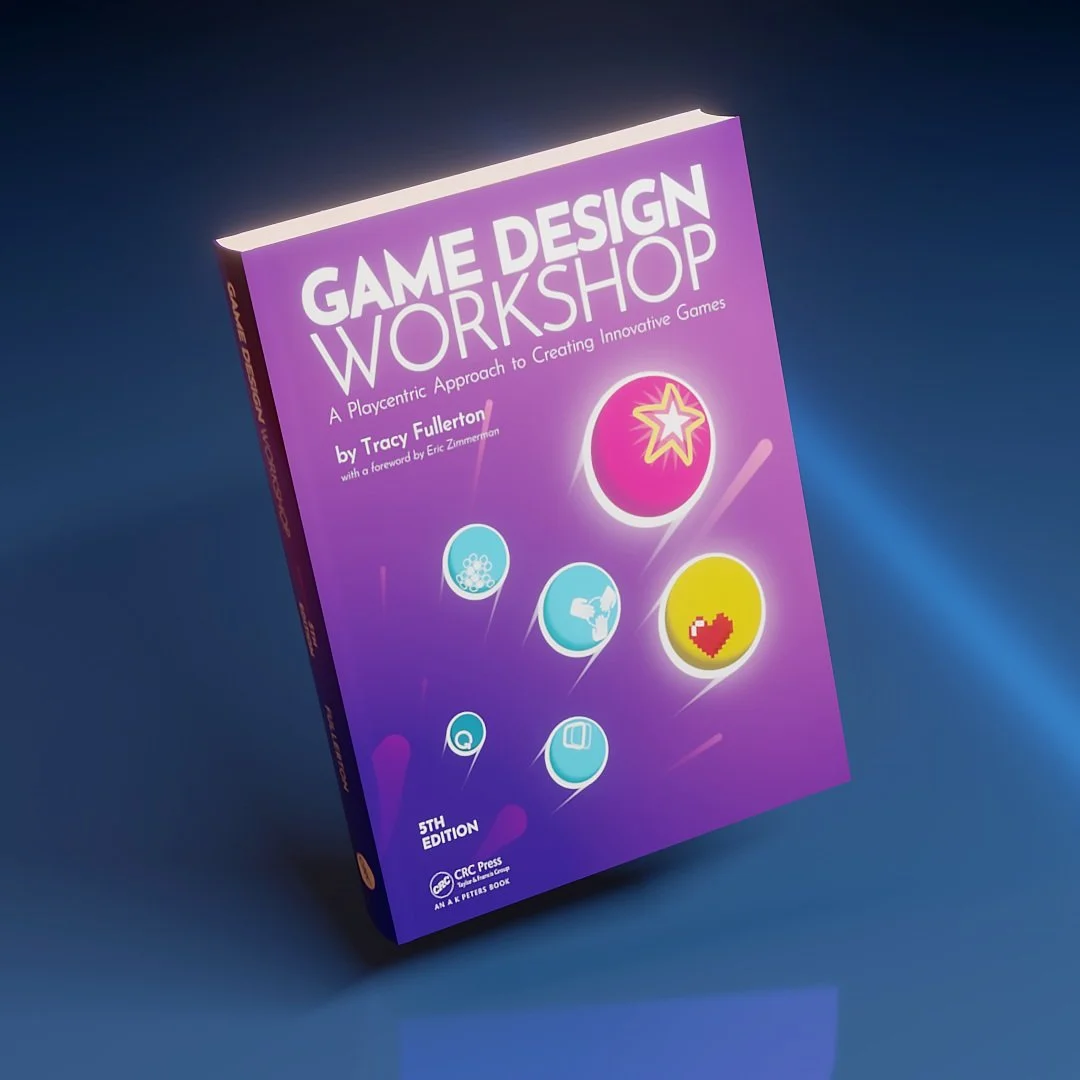
Game Design Workshop,
Game Over, Sheff, David
Hackers, Levy, Stephen
The Grasshopper: Games, Life and Utopia, Suits, Bernard
The Well-Played Game,
DeKoven, Bernie – especially chapters 3, 5, 9 and 10
Settlers of Catan, by Klaus Teuber
Scotland Yard, by Ravensburger
El Grande, by Wolfgang Kramer & Richard Ulrich
Modern Art, by Reiner Knizia
Illuminati, by Steve Jackson
Acquire, by Sid Sackson
Cosmic Encounter, by Bill Eberle, Jack Kittredge, and Bill Norton
Apples to Apples, by Out of the Box
Bernie DeKoven
Bernie's lifelong belief that things can be made more fun
led him to develop and implement new ways of playing, new games groups of all ages
and sizes, from singles, couples and families to schools, communities and
cities. With the 2004 publication of Junkyard Sports, Bernie framed a
recreational program that addresses all of these groups. His 1971 Interplay
Curriculum, a comprehensive program in self-esteem and social skills based on
over 1000 children's games, was used in classrooms and playgrounds throughout
the city of
Bernie has designed award-winning games for Ideal Toy
Company, Children's Television Workshop, CBS Software and Mattel Toys.
Tracy Fullerton
Prior to joining the USC faculty, she was President of the
interactive television game developer, Spiderdance, Inc. Spiderdance’s games included NBC’s Weakest
Link, MTV’s webRIOT, The WB’s No
Boundaries, History Channel’s History IQ, Sony Game Show Network’s Inquizition
and TBS’s Cyber Bond. Before
starting Spiderdance,
Tracy’s work has received numerous industry honors including best Family/Board Game from the Academy of Interactive Arts & Sciences, ID Magazine’s Interactive Design Review, Communication Arts Interactive Design Annual, several New Media Invision awards, iMix Best of Show, the Digital Coast Innovation Award, IBC’s Nombre D’Or, and Time Magazine’s Best of the Web. In December 2001, she was featured in the Hollywood Reporter’s “Women in Entertainment Power 100” issue.